

What kind of inflatable tent would you like?
Privacy statement: Your privacy is very important to Us. Our company promises not to disclose your personal information to any external company with out your explicit permission.


A modular tent system is a versatile, scalable shelter solution designed for rapid deployment in diverse environments. Unlike traditional fixed structures, modular tents from manufacturers like Yangzhou Canway Outdoor Equipment Co., Ltd combine inflatable technology with metallic frame designs to create temporary facilities that are lightweight, durable, and easily transportable.
These systems are engineered for professional buyers who need reliable infrastructure for emergency response, medical operations, military deployments, disaster relief, and outdoor events. The modular nature allows you to expand or contract the footprint as your operational needs change, reducing wasted space and maximizing resource efficiency.
Whether you require an inflatable medical tent for field hospitals, a military-grade rescue tent for defense operations, or a decontamination facility for hazardous material response, modular tent technology provides the structural integrity and flexibility that procurement teams demand.
Yangzhou Canway Outdoor Equipment Co., Ltd operates as a high-tech enterprise integrating design, production, sales, and import-export trade. This vertical integration ensures consistent quality control from raw material sourcing through final delivery.
The company specializes in inflatable tent manufacturing, producing units including medical tents, military tents, decontamination tents, and disaster relief shelters. These products serve institutions such as the United Nations and the Red Cross Society, demonstrating compliance with international humanitarian standards.
Beyond inflatable solutions, the manufacturer produces metallic frame tents that offer permanent or semi-permanent structural options. This dual capability allows buyers to select the optimal shelter type based on duration of use, environmental conditions, and budget constraints.
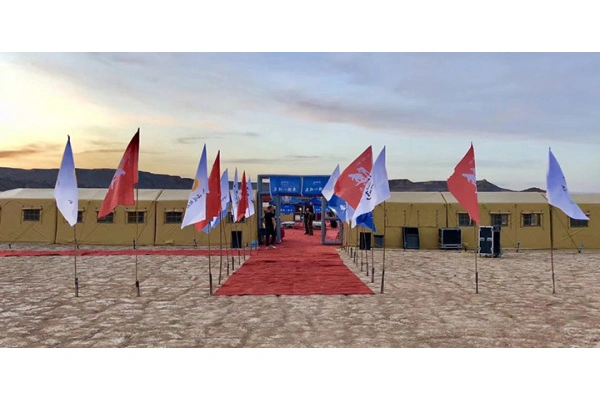
Selecting the appropriate modular tent system requires evaluating multiple factors beyond basic dimensions. Professional procurement decisions should account for deployment environment, intended use case, regulatory requirements, and total cost of ownership including logistics and maintenance.
Consider wind loads, temperature extremes, terrain conditions, and accessibility. Inflatable medical tents excel in rapid-deployment scenarios where speed matters most, while metallic frame tents provide superior durability for extended deployments in harsh climates.
Calculate occupancy needs, equipment volume, and workflow requirements. A single decontamination tent serves individual processing, whereas a mass decontamination tent handles bulk operations. Accurate capacity planning prevents costly over-ordering or under-specification.
Ensure the supplier meets relevant standards for your sector. Medical tents may require healthcare facility certifications, military tents need defense specifications, and disaster relief shelters must comply with humanitarian agency guidelines.
Inflatable tents pack compactly, reducing shipping costs significantly compared to rigid structures. Factor in transportation distance, storage requirements, and setup crew size when calculating total landed cost.
Use this checklist to ensure comprehensive evaluation before committing to a modular tent procurement. Each item addresses common pain points that procurement professionals encounter when sourcing temporary shelter solutions.
When evaluating potential suppliers for modular tent sourcing, prioritize manufacturers with proven track records in institutional procurement. Yangzhou Canway Outdoor Equipment Co., Ltd demonstrates the qualifications that serious buyers should look for.
Suppliers that control both design and manufacturing reduce communication delays, accelerate iteration cycles, and maintain tighter quality control. This integration is critical for custom inflatable tent projects where specifications must translate precisely from concept to production.
A supplier serving organizations like the United Nations and Red Cross Society has already navigated complex procurement processes, compliance requirements, and quality expectations. This experience translates to smoother transactions for new buyers.
Manufacturers offering both inflatable and metallic frame solutions can address diverse project requirements without requiring multiple vendors. This simplifies your supply chain and reduces coordination overhead across different shelter types.
Modular tent applications span critical sectors where rapid, reliable shelter infrastructure is essential. Understanding these use cases helps procurement teams identify the specific features and configurations that match their operational requirements.
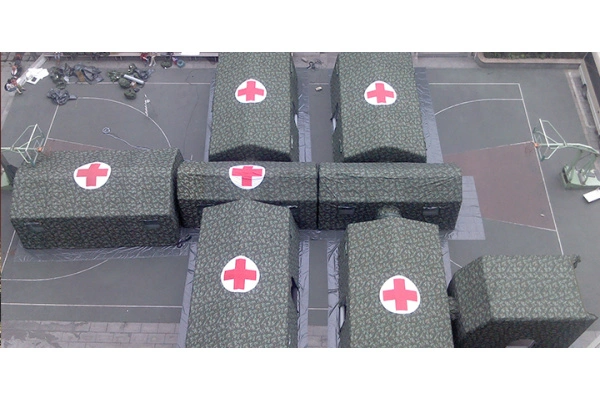
Inflatable medical tents serve as field hospitals, triage centers, and vaccination stations in remote locations or during public health emergencies. These units provide climate-controlled, hygienic environments that meet medical facility standards.
Inflatable military tents provide command centers, barracks, storage facilities, and mobile clinics for defense operations. Their rapid deployment capability and rugged construction make them indispensable for forward operating bases and humanitarian missions.
Inflatable tents for disaster relief deliver immediate shelter infrastructure after natural disasters. Quick setup enables rapid establishment of coordination centers, distribution hubs, and temporary housing.
Single and mass decontamination tents handle hazardous material incidents, chemical spills, and biological threats. These specialized units include filtration systems and containment protocols.
Outdoor camping tents and event shelters support sports competitions, festivals, and recreational activities. Modular configurations allow organizers to scale capacity up or down based on attendance projections.
Procurement professionals frequently encounter challenges when sourcing modular tent systems. Understanding these common pitfalls allows you to proactively address issues before they impact your project timeline, budget, or operational effectiveness.
Many buyers assume inflatable tents deploy instantly without accounting for site preparation, anchoring requirements, and utility connections. Proper ground leveling, wind bracing, and access road planning are essential prerequisites that add to total deployment time.
Standard tent specifications may not account for extreme temperatures, high winds, or heavy precipitation at your deployment site. Buyers should request climate-specific engineering data and consider supplemental heating, cooling, or insulation packages.
Inflatable systems require regular pressure checks, valve inspections, and fabric treatments. Metallic frames need corrosion protection and structural audits. Budget for ongoing maintenance rather than treating it as an afterthought.
Not all manufacturers have the institutional experience required for government or NGO contracts. Verify past performance with similar clients, request reference contacts, and confirm the supplier understands your sector's compliance requirements.
International shipments face customs clearance, import duties, and documentation requirements that can delay delivery by weeks. Work with suppliers experienced in export procedures and ensure all HS codes, certificates of origin, and packing lists are prepared accurately.
Ordering tents based on floor area alone ignores internal volume requirements for equipment, personnel movement, and ventilation. Conduct thorough spatial planning that accounts for furniture, medical devices, or other specialized installations.
These answers address the most common questions from procurement professionals evaluating modular tent systems for institutional use.
Lead times vary based on configuration complexity and order volume. Standard configurations typically require 4-8 weeks from order confirmation to shipment. Custom specifications, including branded interiors or specialized medical equipment integration, may extend timelines to 8-12 weeks. Suppliers with integrated design and production capabilities, like Yangzhou Canway, often achieve faster turnaround times than traders or distributors.
Yes. Reputable manufacturers offer extensive customization options including interior partition layouts, HVAC integration, electrical conduit routing, branding and logo application, and specialized flooring. Medical tents can include isolation rooms, surgical bays, and cold storage compartments. Military variants may incorporate EMI shielding, blast-resistant panels, and communications infrastructure mounts.
Both systems offer strong durability profiles suited to different use cases. Inflatable tents excel in portability and rapid deployment, with modern PVC or vinyl fabrics providing excellent tear resistance and weather protection. Metallic frame tents offer superior long-term structural stability for permanent or semi-permanent installations exceeding one year. For deployments lasting months rather than years, inflatable systems often provide better value due to lower logistics costs and easier relocation.
For medical tents, verify compliance with ISO 13485 quality management standards and relevant healthcare facility regulations. Military contracts may require MIL-SPEC compliance testing. General safety certifications include flame retardancy ratings (such as NFPA 701 or EN 597), fabric tensile strength reports, and structural load calculations. Suppliers serving UN and Red Cross organizations typically maintain documentation packages that satisfy most institutional procurement requirements.
With proper maintenance, inflatable tent systems typically last 5-10 years depending on usage frequency, environmental exposure, and care protocols. Regular inspection of seams, valves, and fabric surfaces extends lifespan significantly. Storage practices—keeping tents clean, dry, and protected from UV degradation when not in use—are critical factors. Metallic frame tents generally exceed 15 years of service life when properly maintained.
Yes, but specifications must match your deployment environment. Manufacturers engineer tents for specific wind load ratings (typically 50-100+ km/h), snow loads, and temperature ranges. Arctic-rated tents include insulated walls and heated air systems, while tropical variants prioritize ventilation and UV protection. Always request engineering data sheets confirming the tent meets or exceeds the environmental conditions at your deployment site before ordering.

Privacy statement: Your privacy is very important to Us. Our company promises not to disclose your personal information to any external company with out your explicit permission.
Fill in more information so that we can get in touch with you faster
Privacy statement: Your privacy is very important to Us. Our company promises not to disclose your personal information to any external company with out your explicit permission.